
12/02/2021
Considerations to properly assess drug stability within biological samples
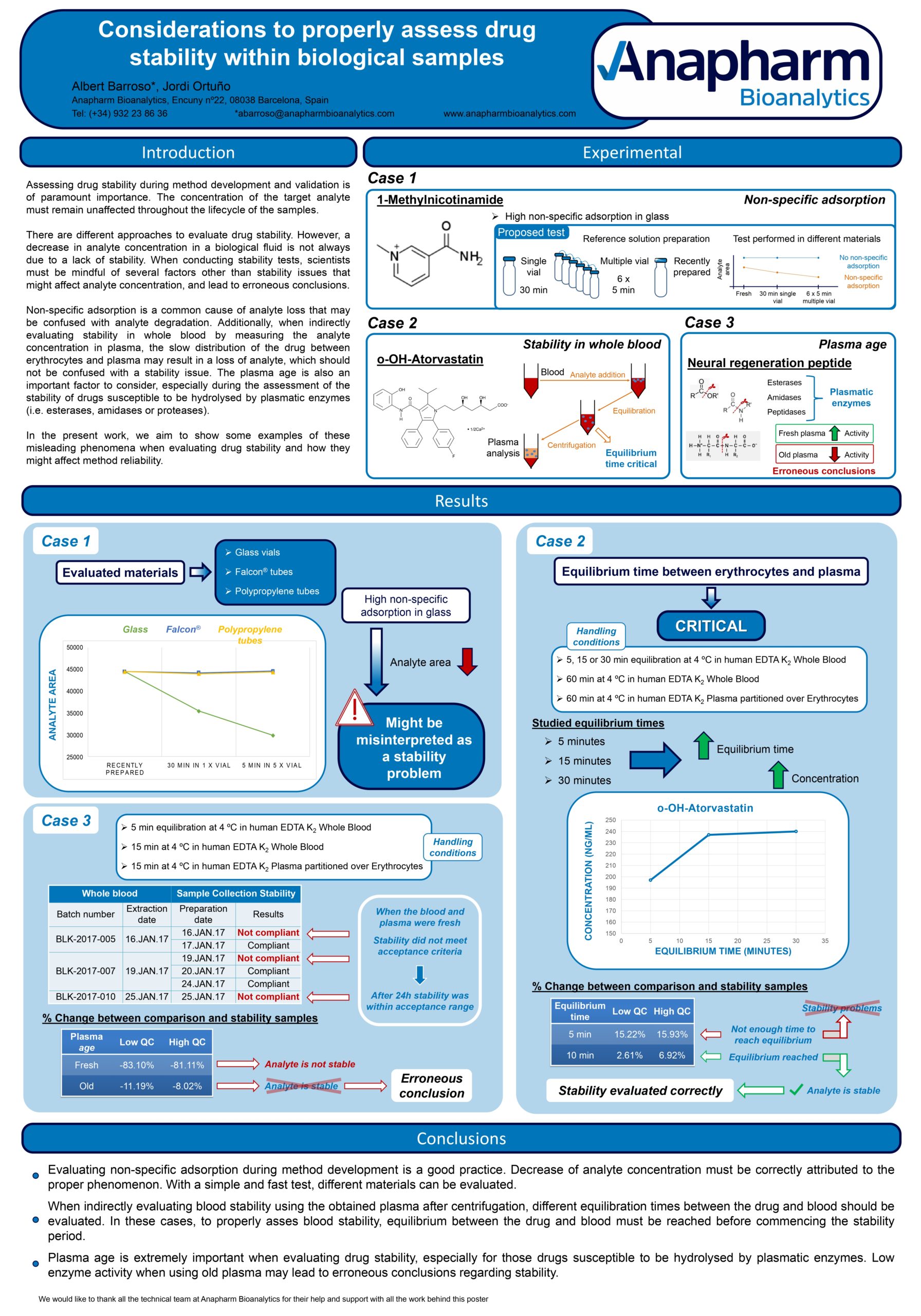
Assessing drug stability during method development and validation is of paramount importance. The concentration of the target analyte must remain unaffected throughout the lifecycle of the samples to ensure the reliability of the assay data. However, a decrease in analyte concentration in a biological fluid is not always due to a lack of stability.
In the work we present to the 14th EBF Open Symposium, we show several factors that can affect analyte concentration and that might lead to erroneous conclusions regarding its stability.
These misleading phenomena are described in the poster and focus on three main points:
• Non-specific adsorption.
• Equilibrium time between erythrocytes and plasma.
• Plasma age.
You may find below the poster for your ready reference:


MORE NEWS
Webinar #1: Navigating Bioanalytical Challenges: from Small Molecules to Complex Peptides
In this 30-minute on-demand webinar, discover practical strategies to troubleshoot common analytical challenges, from small molecules to complex peptides, illustrated with real case studies from our laboratory.
Anti-PEG Antibodies: How Advanced Immunogenicity Testing Overcomes Detection Challenges
Detecting anti-PEG antibodies in clinical immunogenicity testing of PEGylated therapeutics presents unique bioanalytical challenges: from PEG’s repetitive structure causing low signal-to-noise ratios in standard assay formats, to selecting appropriate positive controls and distinguishing anti-drug from anti-PEG antibodies. This blog describes how the bioanalytical team at Anapharm Bioanalytics addressed these challenges during the development and validation of an immunogenicity assay using the Affinity Capture Elution–AGL (ACE-AGL) MSD immunoassay format.
Protein Digestion for LC-MS Bioanalysis: Comparing Standard and Kit-Based Methods
Quantitative bioanalysis of therapeutic proteins via liquid chromatography–mass spectrometry (LC-MS) typically relies on the analysis of surrogate peptides rather than intact proteins. Selecting the right digestion method impacts sensitivity, reproducibility, and cost. This blog compares three approaches tested in-house at Anapharm: standard trypsin digestion, the use of a kit with a thermostable immobilized trypsin, and a kit with ready-to-use reagents.